
World AMR Awareness Week, 18-24 November 2025
This week marks WHO Antimicrobial Resistance Awareness Week 2025, and we want to share what the AMAST Network is doing to combat one of the biggest threats to global health, food security, and agriculture.
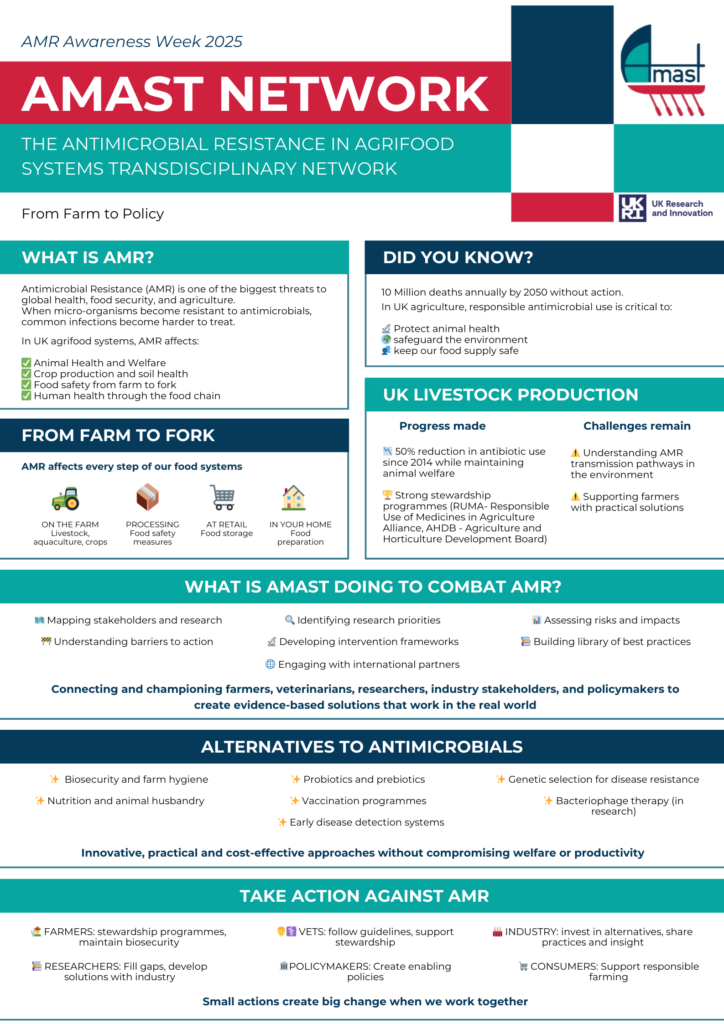
Understanding the Challenge
Antimicrobial Resistance (AMR) happens when microorganisms become resistant to antimicrobials, making common infections harder to treat. Without action, AMR could cause 10 million deaths annually by 2050. The impact is felt throughout our food systems, affecting animal health and welfare, crop production and soil health, food safety from farm to fork, and human health through the food chain.
How AMAST Is Making a Difference
The AMAST Network brings together farmers, veterinarians, researchers, industry stakeholders, and policymakers to create evidence-based solutions that work in the real world. Our approach spans the entire agrifood system, from farm to policy.
Since our launch in November 2024, AMAST has been busy building partnerships and gathering insights from across the sector. We’ve established strong relationships with key organisations and delivered focused workshops to tackle specific challenges in different livestock sectors.
Read our Launch Meeting Report to learn about our strategic roadmap and the priorities identified by our partners from across industry, research, government, and healthcare sectors.
Sector-Specific Work
Pigs: In April 2025, we brought together over 50 stakeholders at the National Pig Centre to address ongoing antimicrobial use challenges in pig production. The forum identified practical opportunities for continued improvement while acknowledging economic realities facing producers. Explore the Pig Sector Report.
Ruminants: We’re partnering with RCVS Knowledge to develop the UK Ruminant Sector Antibiotic Stewardship Roadmap to address challenges in antimicrobial use monitoring for the ruminant sector.
Looking Ahead
AMAST continues to expand our network and deepen our engagement with stakeholders across the agrifood systems. We are committed to ensure that the voices of farmers, veterinarians, and other practitioners shape the solutions we develop.
The AMAST Network is funded by UK Research and Innovation (UKRI) and brings together expertise from across the UK to address antimicrobial resistance in agrifood systems through transdisciplinary collaboration.